
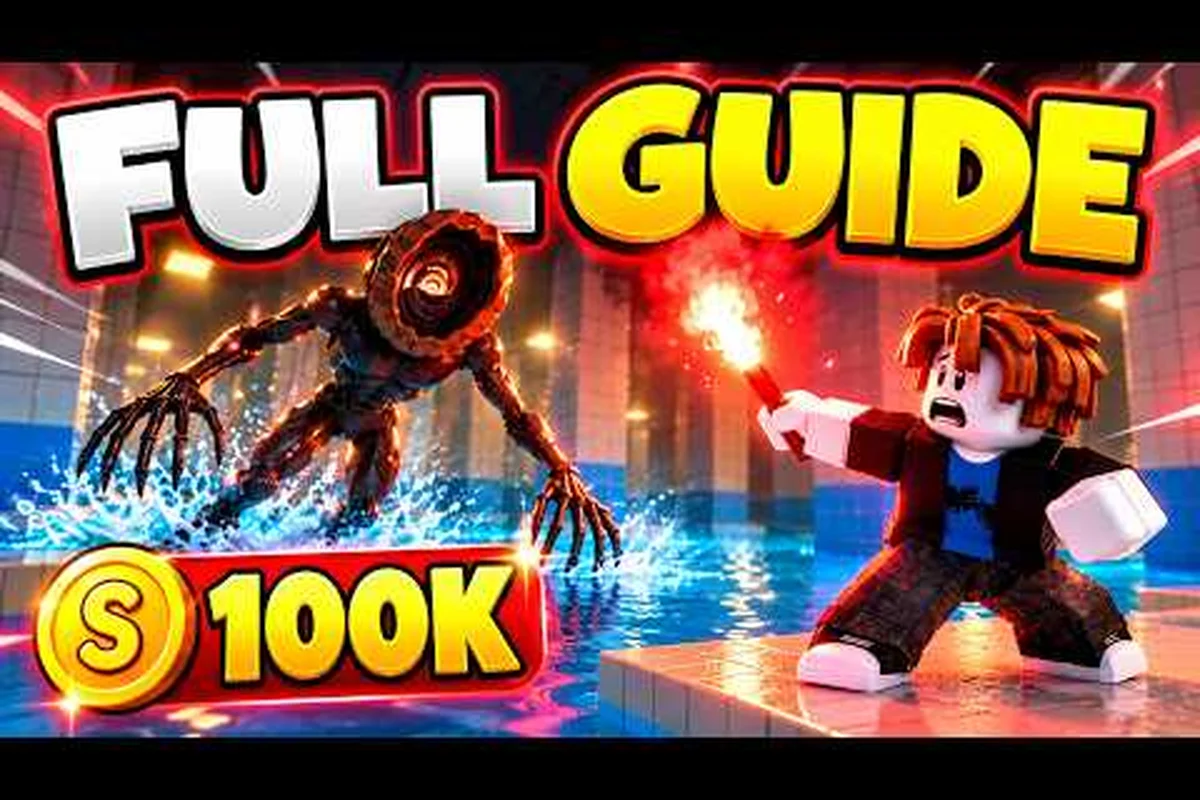
Survive DONT SPLASH by treating every water contact as a signal. The blind monster cannot see you, but it detects splashes and other water sounds, so your movement pattern matters more than sightlines. This dont splash monster guide explains how it patrols below the surface and how to redirect it with quiet routes and pebble lures: for example, create one splash in a safe channel, then move along a dry edge while the monster investigates the noise elsewhere.
What Makes the DONT SPLASH Monster React
The creature called IT does not rely on sight. This makes the DONT SPLASH blind monster a fundamentally different threat from an enemy that follows your camera or waits around corners. IT moves beneath the water and investigates sounds connected with splashes, so staying away from the liquid is more valuable than simply facing away from danger.
The official DONT SPLASH game page describes the core rule: IT is blind and cannot see avatars. That means a creature directly ahead is not necessarily dangerous, while a loud landing behind you can be exactly what triggers a charge. The absence of vision also explains why players can sometimes move right beside it without being noticed.
Understanding that distinction changes the entire route through a level. You do not need to break line of sight or hide behind geometry in the conventional sense. Your priority is to avoid creating an audible splash, especially near the route you still need to cross.
| What IT responds to | What IT does not need | Practical implication |
|---|---|---|
| Water contact from a fall | A clear view of your avatar | Keep jumps short and land on dry surfaces |
| Water contact during a jump | Your character to be nearby | Avoid clipping pools in midair |
| A thrown object hitting water | The object to belong to you | Use a pebble as a decoy |
| Dry movement | A visible target | Quiet platforming can be safer than hiding |
This is the basis of the sound based monster mechanic. IT hears the relevant water noise rather than tracking your position visually, and it responds to the sound's location. A splash may cause the creature to charge toward that point, interrupt a jump, or lead it into the middle of your intended path.
Why Blindness Changes Every Chase
A visual enemy can be escaped by looking away, hiding behind a wall, or changing direction. IT cannot do any of those things, so hiding has limited value unless it also prevents noise. The relevant question is not “Can IT see me?” but “Have I made a sound it can investigate?”
The important phrase is IT only hears water in the context of its hunting trigger. Footsteps and ordinary character movement may still produce game audio, but they are not the specific signal that sends the creature charging. A quiet landing on a dry platform is therefore far better than a risky jump into a narrow pool, even if the dry platform is exposed.
That rule also explains the strategy behind dry-platform routes. You can keep moving while IT patrols elsewhere, provided you do not accidentally create a splash. The goal is to separate your route from its route instead of trying to outrun a pursuer that cannot identify you visually.
DONT SPLASH Monster Guide: Reading IT’s Behavior
IT normally patrols silently under the water. Community walkthroughs show it moving beneath the surface and committing to a charge only after a splash is detected. The transition from patrol to pursuit is therefore tied to a sound event, which makes timing more useful than raw reflex speed.
Audio cues become especially important because IT has no visual confirmation of its target. Reported player experience suggests that the creature gives distinct sounds while moving, turning, or preparing to charge. Headphones can help you hear those cues before the danger becomes obvious, but the cue should be treated as a warning rather than an exact distance measurement.
A verified DONT SPLASH walkthrough by Zac Worthy demonstrates the central behavior loop: silent underwater patrol, a reaction to splash sounds, and a charge toward the sound's location. The footage also shows that entering water during a jump can lead to an interception, which means the danger exists before your feet reach the surface.
| Phase | Likely behavior | What you should do |
|---|---|---|
| Underwater patrol | IT moves quietly below the water | Follow dry routes and listen for cues |
| First splash cue | IT reacts or changes direction | Stop moving toward the water |
| Charge | IT travels toward the splash zone | Change course without entering the liquid |
| Interception | IT reaches the noise area or catches the player | Use a decoy and create distance |
| Return to patrol | IT resumes movement after the distraction | Continue only after the route is clear |
The phrase Splash Zone is useful here because it describes the area IT investigates after hearing water. You do not need to know the exact coordinates of the creature. You need to know where your noise occurred, because that is where the charge is likely to go.
Patrol, Charge, and Reset
IT does not track players continuously; it reacts to water disturbance. A Charge begins when a splash registers as a sound source, and Reset occurs only after that pursuit ends. For example, if a failed jump draws IT toward a side pool, wait for the charge path to clear before using the opposite bank; crossing immediately can leave you inside its hearing range. The key is to read IT’s movement between Patrol, Charge, and Reset rather than treating the encounter as a permanent chase.
During patrol, IT moves below the water without pursuing a visible player. After a splash, it enters charge and heads toward the source. If the disturbance is far enough away, the charge can pull it away from your destination. Once the event passes, IT returns to its normal behavior, although the exact reset time can vary by stage and situation.
Splash Redirect is the central skill: deliberately create a noise somewhere you are not. Community footage shows a pebble lure pulling the creature toward distant water. That lets you create a false destination, wait for IT to commit, and then cross the area it previously guarded.
Preventing Splashes and Avoiding the Chase
The safest route is the one that never creates a sound. Plan dry landings first, treat pools as hazards, and use the pebble as a pressure release rather than as an unlimited escape. A controlled decoy is better than a panic jump because a decoy gives IT a clear target while keeping your avatar away from the impact zone.
Start by identifying every water transition in the stage. Separate unavoidable crossings from optional ones, then look for a dry detour. If a pool cuts directly across the only route, use a pebble before crossing rather than after a splash has already brought IT toward you.
| Situation | Risk level | Better response |
|---|---|---|
| Dry platform route available | Low | Move directly and keep your footing |
| Small pool with a clear opposite bank | Medium | Use a pebble first, then cross |
| Water lies beyond a required landing | High | Rethink the approach and create distance |
| IT is already charging | Critical | Abandon the direct line and use another decoy |
| No dry route remains | Extreme | Time the lure and commit only after IT moves |
The most important habit is Dry-Landing Commitment. When you approach a jump, identify the exact landing surface before taking off. If the target is wet, do not assume you can correct in midair. The verified gameplay demonstrates how a midair water clip can produce a splash and allow IT to intercept you.
Pebble Lures Work Best Before the Commitment
A pebble is most valuable when IT is still patrolling. Throw it toward distant water, wait for the creature to commit, and then move along the route it has just abandoned. Throwing the pebble after IT is already chasing can still work, but it may place the new sound close to you and create a second unpredictable interaction.
The no-commentary stage footage from Peta Perjalanan shows dry landings remaining quiet while water contact produces a reaction. It also demonstrates the pebble in practice, with the decoy drawing IT away from the player's intended line. This supports a deliberate sequence: identify the pool, select a far landing, lure IT, cross, and stop before making another sound.
| Lure timing | Expected result | Main risk |
|---|---|---|
| Before entering the danger zone | IT commits toward distant water | The thrown object may land too close |
| While IT patrols nearby | Best chance of a clear diversion | Waiting exposes your position to nearby cues |
| During an active charge | It may redirect, but unpredictably | The creature may already be near the route |
| After IT reaches your splash zone | Usually too late to protect that spot | Immediate contact or a jumpscare |
For more detailed lure timing, the companion guide to distracting the creature in DONT SPLASH explains how pebble throws affect the patrol without requiring a direct confrontation. A good example is throwing the pebble across the far side of a pool before entering the danger zone: if IT commits toward the water impact, the abandoned patrol route becomes safer to cross. Avoid landing the pebble beside your intended path, because the new sound could pull IT toward you instead of away.
Sound Cues, Timing, and Route Planning
DONT SPLASH it only hears water is not a reason to stop using sound entirely. It means water is the trigger that matters for IT's pursuit. Underwater movement, directional changes, and attack preparation can still help you judge what the creature is doing, especially when visual information is limited.
A DONT SPLASH tips video by TonyCool highlights the sound-based design and explains that the creature can charge without needing line of sight. Experienced players use audio to estimate the monster's position and movement. Because playback conditions differ, the sounds are most reliable as directional warnings rather than precise radar.
Use a three-part timing routine. First, Listen for Position. A distant rumble or movement may reveal that IT is beneath or beyond the next pool. Second, Predict the Commitment. If it is already investigating one splash, avoid making another nearby one. Third, Move on a Dry Bearing. Select the next surface before the creature finishes reacting, because hesitation can turn a safe route into a second noise event.
Build Routes Around Sound Dead Zones
Sound dead zones are not necessarily silent areas. They are parts of the route where your splash would be poorly placed, such as a pool directly beside a narrow platform. You can move through these spaces if IT is elsewhere, but creating a noise there can send it straight into the corridor.
Think in terms of Noise Geography: map where the creature is likely to stand, listen for the direction of its attention, and place each pebble to change the path between you and the monster. Because IT primarily tracks water sounds, a splash near a wall or doorway can make the creature cross an otherwise safe corridor, while a splash in a dead zone may only attract it to a confined corner. Use the level’s pools, narrow platforms, and sightline breaks as landmarks when choosing the next throw, rather than simply aiming for the loudest reachable target.
-
Close Noise has a small diversion benefit and can pull IT toward you.
-
Mid-Range Noise is useful for opening a nearby crossing.
-
Far Noise creates the largest travel distance but requires a reliable throwing angle.
-
Layered Noise uses several splashes, which can create confusion but also risks revealing your true route.
Do not assume a louder lure is always better. The best decoy is placed where you need IT to go, not where it is easiest to make the greatest noise. Route planning turns the pebble into a precise tool for moving the threat through the level.
For a closer look at the broader sound design, including how it supports the horror atmosphere, read DONT SPLASH sound design and hidden lore clues. That companion explanation can help you distinguish meaningful creature cues from ordinary environmental audio.
Advanced Survival Tactics for the Blind Monster
The DONT SPLASH monster can't see you, yet that does not make it harmless. IT may still occupy the exact water you need, react to a pebble landing at the wrong distance, or intercept you after a failed jump. Advanced survival depends on controlling the information IT receives and keeping multiple escape options available.
First, choose a Primary Decoy Position rather than throwing at the first visible pool. Ideally, it should be beyond your intended crossing and far enough away that IT must leave the critical route. Then select a Fallback Crossing in case the decoy lands incorrectly. A small dry ledge, a parallel platform, or another visible section of water can provide a second path.
Second, avoid stacking disturbances. If a previous splash has already sent IT toward the area, throwing another pebble nearby may merely relocate the threat. Wait until the creature commits in the opposite direction, then use the quiet interval to cross. Patience is more reliable than rapidly triggering multiple sounds.
Third, keep your movements decisive. A player who hesitates at the edge, backs into a puddle, or makes repeated partial jumps can create accidental splashes. The most successful approaches shown in gameplay treat a jump as a single planned action: check the landing, commit, and land dry.
The DONT SPLASH gameplay by UnoTwo shows the consequence of contact: IT reaches the player and the run ends with a jumpscare. The footage also demonstrates that players cannot kill the creature. Your defenses are avoidance, diversion, and distance rather than a weapon or temporary combat tactic.
| Survival principle | What it prevents | How to apply it |
|---|---|---|
| One planned sound at a time | Unpredictable redirection | Wait for IT to commit before another lure |
| Dry landing check | Midair interception | Confirm the landing surface before jumping |
| Two-route planning | Forced close-range contact | Identify a fallback before touching the first pebble |
| Sound-based tracking | Walking into a charge | Pause at route corners and listen |
| Maximum distance from decoy | Immediate reversal | Place the lure beyond the threatened crossing |
For a broader breakdown of pursuit states and water-sensitive creature behavior, consult the DONT SPLASH water-sensitive monster mechanics guide. Its pursuit-state breakdown helps explain why IT may remain fixed after a missed pebble, pursue a confirmed splash, or reverse course when the sound source changes. Use that distinction to decide whether waiting, redirecting IT, or taking the fallback crossing will preserve the greatest distance from the DONT SPLASH monster.
Frequently Asked Questions
Can the monster in DONT SPLASH see the player?
No. IT is blind and cannot see avatars, so looking away or breaking line of sight will not protect you. The creature investigates relevant water sounds instead, including splashes caused by falling, touching water during a jump, or an object landing in a pool.
What makes the DONT SPLASH monster chase a player?
IT reacts to water noise and charges toward the source of the splash. A sound does not need to come from the player's own body, which is why throwing a pebble into distant water can pull the creature away from a planned route.
Should players run away when IT starts charging?
Running blindly may create another splash, and the creature does not need to see you. Change to a dry route, avoid entering the charged area, and create distance. A pebble can redirect IT when used before the charge reaches your position.
Can the monster be killed or permanently stopped?
The creature cannot be killed, according to verified gameplay. Players can only avoid its search zone, redirect it with a pebble lure, and wait for it to return to patrol. Prevention is therefore more reliable than trying to defeat IT.
Is a pebble safe to use around water?
It is useful when thrown toward a suitable pool away from your route. The decoy should be distant enough to pull IT away, and it should be used before crossing rather than after a nearby splash has already attracted the creature.