
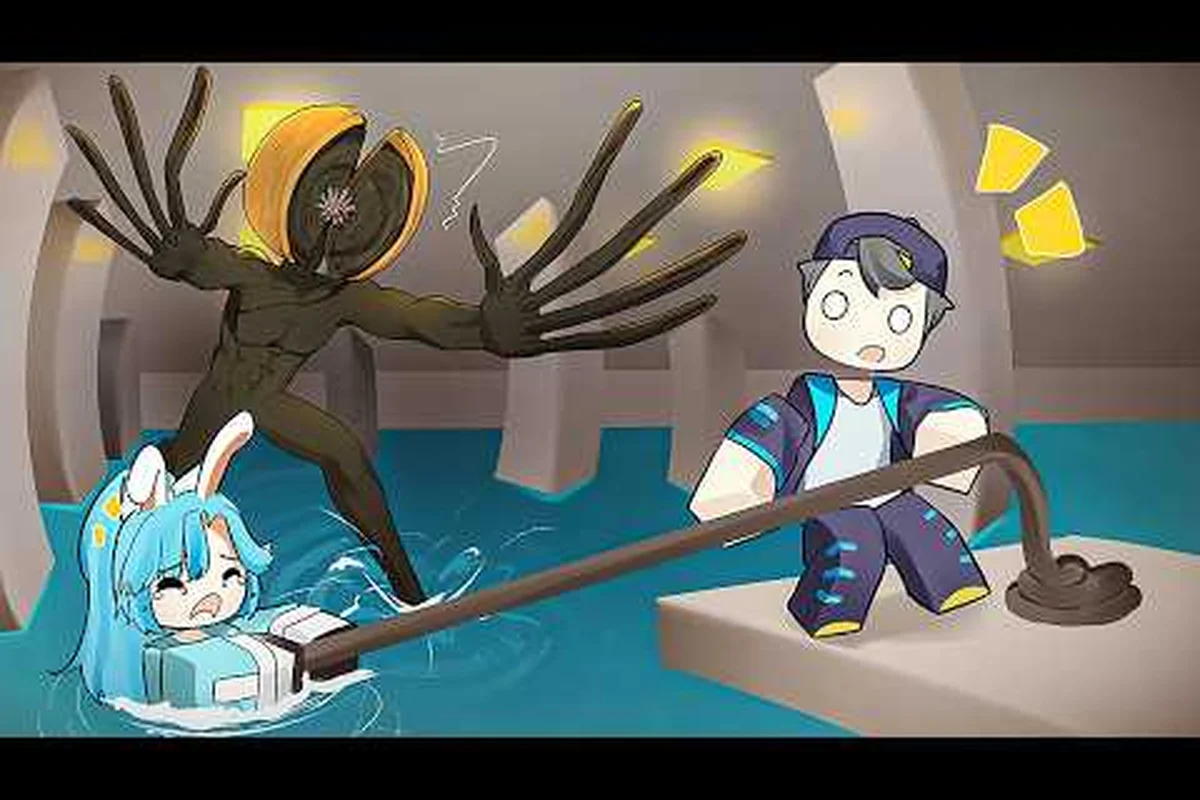
DONT SPLASH sound design matters because the creature’s threat is communicated through sound: water reveals movement, silence conceals intent, and every corridor seems to listen. By studying the game’s audio cues, you can better understand how DONT SPLASH turns ordinary footsteps, splashes, and echoes into a convincing audio horror experience.
DONT SPLASH sound design and the logic of listening
DONT SPLASH is built around a simple but effective inversion: water is normally treated as scenery, yet here it becomes a source of danger. The official DONT SPLASH game page on Roblox describes an eerie, flooded environment, while the tagline “DONT SPLASH, IT KNOWS” gives the central warning a direct relationship to sound. That connection is the foundation of the game’s sound design, because a splash is not merely a gameplay effect; it is a message sent through the entire complex.
The best way to understand dont splash sound design is to divide it into three layers: environmental signal, creature signal, and player signal. Environmental signals include dripping water, echoes, and reverberating rooms. Creature signals may take the form of a movement cue, a sudden change in ambience, or the silence that follows a nearby noise. Player signals are the sounds produced by your own body, especially footsteps, jumps, and contact with water.
| Sound layer | Likely source | Player interpretation | Horror function |
|---|---|---|---|
| Environmental ambience | Water, tiles, distant rooms | The complex is active around you | Establishes place and uncertainty |
| Player signal | Footsteps, jumps, splashes | IT may detect you | Creates cause-and-effect tension |
| Creature signal | Movement, pursuit, sudden audio changes | IT is near or approaching | Rewards careful listening |
| Silence | Missing expected environmental noise | Something may have changed | Turns absence into a warning |
This layered structure makes dont splash audio horror more than a collection of scary noises. Each sound can occupy several roles at once. A footstep may simply confirm movement, yet it can also reveal distance, surface conditions, and whether the player has accidentally entered a water-filled area. The same event can therefore function as a navigation tool, a risk signal, and a source of lore.
The setting also makes every sound unusually clear. Blue-gray tiled corridors, still pools, and long empty spaces resemble a liminal complex rather than an ordinary building. Walkthrough footage from Zac Worthy shows warm lighting suspended over the flooded halls, which creates a strong visual contrast: the rooms look inviting, but their emptiness makes every audio interruption feel deliberate.
How water turns sound into a monster signal
The phrase dont splash the water is the enemy is a practical warning and a possible description of the game’s lore at the same time. Water amplifies noise, carries it through open corridors, and gives IT a clear reason to move toward the source. A dry footstep can remain local, while a splash announces both position and disturbance. That difference makes the player’s route choice part of the horror experience.
| Surface or action | Likely acoustic result | Strategic implication |
|---|---|---|
| Dry floor movement | Small, contained footstep | Lower exposure, but movement still needs monitoring |
| Shallow water | Distinct splashing and ripples | Avoid when IT may be nearby |
| Deep water | Strong splash and prolonged disturbance | Treat as a major alert event |
| Running | Repeated steps with faster rhythm | Useful for escape, risky while concealed |
| Standing still | Very little player-generated sound | Best option when danger is uncertain |
| Jumping | Brief impact or landing sound | Avoid near an active pursuit zone |
The important point is not that every sound has a precise decibel value. The available official material does not publish a detailed sound meter or numerical detection radius. Instead, player experience and no-commentary gameplay footage show a readable pattern: splashes stand out against the controlled ambience, while quiet movement leaves more room for environmental clues. Any claim about an exact detection range should therefore be treated as community observation rather than a confirmed statistic.
This uncertainty is central to the design. If every noise produced the same response, the game would become a simple noise meter. Instead, sound varies by context. The same splash may be harmless when IT is far away, yet it can become a directional warning when the creature is near a pool. A distant footstep may be harmless in a large chamber, while the same sound could be dangerous in a narrow passage. Players learn the acoustic geography through repeated exposure.
The flooded corridors also create acoustic uncertainty. Water can conceal the exact source of a sound, and tile-lined spaces may make a small movement seem farther away than it really is. That ambiguity supports the creature’s identity as IT: a presence known mainly through what it does when sound reaches it, rather than through a detailed physical design.
Quiet footsteps, warning cues, and the value of silence
A common instinct in horror games is to keep the soundtrack loud so the player feels constant danger. DONT SPLASH appears to use a more restrained approach. The atmosphere can remain sparse, letting small sounds feel unusually important. This is why the dont splash sound design is best experienced with headphones: fine details that would disappear on a laptop speaker may become the difference between a safe route and a detected mistake.
Silence also changes how players interpret the environment. When the background remains active, a missing drip or echo may be easy to overlook. When the mix becomes unusually empty, the absence may feel like an interruption. Community reports often describe the horror as quiet and liminal, particularly when comparing the experience with Poolrooms-inspired content. The atmosphere is not built around constant aggression; it is built around waiting for something to happen.
| Audio clue | What it may indicate | Practical response |
|---|---|---|
| Footsteps remain audible | IT is moving nearby | Stop and identify the direction |
| A splash sounds distant | The player is not yet detected | Pause before crossing water |
| A splash sounds immediate | IT is very close | Hide, retreat, or prepare to move |
| Echoes cut off | Space or obstruction changes | Reassess the next doorway |
| Ambient sound fades | IT may be close | Freeze and listen |
| A sudden loud cue begins | Pursuit may be underway | Move decisively toward an escape route |
These are interpretive cues rather than promised UI signals. The game does not need to display a danger meter if its sound palette already produces a meaningful reaction. Silence gives the player space to notice a change, while a sudden increase in volume can communicate the instant a safe interval ends.
This also explains why the creature feels frightening even when it is not visible. The player is forced to construct its position from indirect evidence. A splash, a missing echo, or a directional footstep can all become a mental marker. The wider creature guide for DONT SPLASH explores how IT’s behavior connects to sound and movement, while this article focuses on what the audio communicates before the chase is visually confirmed.
The strongest listening strategy is contrast. Do not focus only on the loudest sound; compare the current scene with the sounds that were present a moment earlier. If the dripping continues but your own steps sound wrong, the floor may be wet. If the room’s echo changes, a large body may be moving nearby. If everything becomes quiet, treat that quiet as information rather than comfort.
DONT SPLASH audio horror and the anatomy of a jumpscare
A jumpscare is usually remembered for its image, but sound determines whether the moment feels random or inevitable. The dont splash jumpscare lore is less about a specific monster reveal than about a change in acoustic control. Before danger arrives, the player is allowed to interpret the sounds. Once the encounter begins, those same categories can become overwhelming, sudden, or impossible to ignore.
The sound design appears to rely on three forms of escalation:
-
Environmental interruption: a familiar ambient layer changes or disappears.
-
Spatial localization: a new sound suggests IT’s position relative to the player.
-
Aggressive pursuit: rapid movement, splashing, or a sudden loud event confirms that hesitation is no longer safe.
| Stage | Dominant sound | Player knowledge | Emotional effect |
|---|---|---|---|
| Exploration | Drips, tile echoes, distant ambience | IT may exist but is unlocated | Curiosity and unease |
| Suspicion | Irregular footsteps or an altered ambience | IT could be in the same area | Hypervigilance |
| Detection | A player splash or stronger pursuit cue | Exposure has likely occurred | Panic |
| Chase | Rapid, layered movement sounds | Immediate escape is necessary | Survival urgency |
| Aftermath | Ambience returns without explanation | The threat remains unresolved | Lingering dread |
This escalation is more effective when players can trace it backward. After a chase, a player may remember that a room sounded too quiet, or that a distant splash came from the wrong direction. The scare then becomes evidence of a system rather than a random noise. Community discussion often focuses on the visual image of IT, but the audio provides the causal chain leading to that reveal.
The creature’s simple name reinforces the same idea. IT has little explanatory lore in the official description, so sound becomes a substitute for biography. The player learns that it hears, approaches, and reacts without receiving a speech, document, or expository scene. IT is not presented as a character with motives so much as a behavioral force inside the complex.
That distinction also helps explain the difference between horror and obstacle-course play. DONT SPLASH includes repeated movement challenges, but the dont splash horror vs obby comparison depends on the soundtrack. An obby usually asks whether the player can execute a jump. This game asks whether the player can make the same movement without producing an unwanted acoustic signal. The platforming challenge can therefore become a horror challenge whenever a required route crosses water.
Hidden lore in footsteps, echoes, and environmental contradictions
The most convincing dont splash lore hints are likely to be environmental rather than written. A flooded complex with no visible purpose, repeated corridors, and a creature that responds to sound all raise questions the game never needs to answer directly. The audio can suggest that the facility is active, abandoned, submerged, or caught in a repeating cycle. It may also imply that IT is less an intruder than an established part of the system.
A useful way to search for dont splash hidden lore is to separate what the player hears from what the player assumes. The direct evidence is a sound, a surface, a light, or a movement. The assumption is that the complex is a pool, a laboratory, a prison, or a place where IT was created. Keeping those layers separate prevents lore theories from becoming unsupported statements.
| Observable detail | Sound-based interpretation | Possible lore direction |
|---|---|---|
| Water occupies connected corridors | Echoes travel irregularly | The site may have been designed around flooded channels |
| No obvious source for the flooding | Drips seem endless | The condition may be permanent or cyclical |
| IT reacts to noise but receives no exposition | Pursuit follows a simple rule | The creature may be a sensory security system |
| Spaces feel repetitive | Similar echoes recur | The complex may loop or collapse familiar geography |
| Warm lights contrast with cold tiles | Footsteps sound exposed | Safety is visual, while sound remains dangerous |
The official game page explicitly compares the atmosphere to Poolrooms and House of the Locust. That comparison does not prove a literal connection, but it does clarify the intended mood: dreamlike architecture, oppressive emptiness, and a constant sense of being observed. The DONT SPLASH lore analysis of its Poolrooms-inspired setting expands on that visual foundation, while the soundtrack adds a sensory rule that the architecture alone cannot provide.
Repeated audio patterns may also help players notice changes. If the same corridor produces the same echo, a deviation can stand out. If dripping is irregular, a sudden rhythm change can suggest that IT is approaching. These observations should not be promoted to confirmed facts, because the game provides little direct explanation. Their value lies in testing theories against consistent player experience.
Community-reported lore should be handled with similar care. A player’s belief that IT cannot see, for example, may be based on behavior rather than an official statement. The more defensible claim is that sound appears to be a strong detection mechanism and that visual conditions make observation difficult. That distinction is important because it preserves useful information without turning community inference into an unsupported rule.
Reading the audio horror through a practical sound map
Players can turn dont splash audio horror into a more consistent survival practice by creating a mental sound map. The goal is not to memorize every corridor; it is to identify recurring acoustic zones and adjust movement accordingly. This approach also makes the environmental art easier to read, since lighting, tile layout, and floor appearance can help predict what a room will sound like.
| Zone type | Expected audio character | Best movement rule |
|---|---|---|
| Dry corridor | Compact steps and short echoes | Move slowly while IT may be close |
| Poolside passage | Drips, splashes, and wider resonance | Avoid the water and wait at the edge |
| Large tiled hall | Long echoes and distant ambience | Use directional sound to locate movement |
| Narrow service path | Close reflections and abrupt echoes | Pause frequently to detect pursuit |
| Water-heavy chamber | Continuous splashing and overlapping noise | Treat any exposed water as a major risk |
A practical method is to assign each area a risk color based on surface exposure, echo length, and escape routes. A short corridor with a deep pool may be more dangerous than an open hall because the player has little room to retreat after a splash. A large hall may be safer when dry because distant footsteps can be localized before IT reaches the player.
The same map can be used while escaping. A sound traveling from behind a wall may suggest a different path than a sound crossing an open chamber. Players who recognize the acoustics can move toward dry, absorbent spaces and away from reflective water. That practice also reduces the risk of confusing the player’s own breathing with an environmental change.
| Listening step | Question to ask | Action |
|---|---|---|
| Stop | Is there a new sound? | Freeze before producing another step |
| Compare | Did the ambience change? | Check for an approaching presence |
| Locate | Does the sound come from ahead, behind, or below? | Turn carefully and plan an escape |
| Assess | Will the next surface make noise? | Choose a dry route |
| Move | Can urgency outweigh the risk? | Sprint only when exposure is unavoidable |
The DONT SPLASH chase guide is useful after a detection event, particularly for understanding how player-generated noise affects pursuit. Before a chase, the sound map is about prevention: it helps the player identify danger while there is still time to choose a quieter path.
No-commentary footage is especially valuable for this analysis because it lets the soundtrack remain continuous. A no-commentary DONT SPLASH run shows featureless walls, repeated tiled rooms, and flooded passages with little dialogue competing for attention. The result is closer to a sensory field recording: water, space, and the player’s own actions become the narrative.
Why silence is the game’s strongest hidden rule
Although the official tagline focuses on splashing, the broader design implies that controlled silence is the player’s strongest defense. This is not simply because IT reacts to noise. Silence also limits the amount of evidence the player can use, creating a tradeoff: moving slowly reduces exposure but gives the creature more time to approach, while moving quickly improves escape speed but makes detection more likely.
That tradeoff is what separates the game from a basic chase. A route can be technically correct yet acoustically disastrous. Another route can look longer while remaining safer because it passes over dry flooring. Skilled play therefore combines navigation, timing, and sound awareness. The player is not just choosing where to go; they are choosing what information to reveal.
| Choice | Immediate benefit | Hidden cost or risk |
|---|---|---|
| Walk slowly | Less obvious noise | IT has more time to close distance |
| Run through water | Greater movement speed | Loud splash exposes position |
| Wait in silence | Minimal sound signature | Less knowledge of IT’s location |
| Make a controlled sound | Can test whether IT reacts | May create an unwanted detection event |
| Use a distant room | Creates an apparent noise source | Can misdirect danger toward another area |
Whether IT can be deliberately distracted remains uncertain in available community information. Players should treat that behavior as a possible mechanic only when it reproduces consistently. The dependable principle is simpler: sound can direct attention, and attention changes the danger around the player.
This makes silence narratively meaningful. A loud horror game tells the player that danger is present. DONT SPLASH uses near-silence to suggest that danger is present even when the monster cannot be seen. The DONT SPLASH obby guide can clarify the platforming routes, but the lore interpretation changes when every jump and landing is considered a possible acoustic event.
Silence should therefore be understood as active uncertainty, not an empty soundtrack. The player listens for what is missing, remembers how the room should sound, and treats sudden clarity as a warning. In that sense, IT is not only the monster hearing the player; the player is also trying to hear the monster without giving IT an equally useful signal.
Frequently Asked Questions
Does DONT SPLASH have an official sound or detection meter?
No official sound or detection meter appears in the available game information. The evidence instead comes from the water-focused tagline, observable sound behavior, and player footage. Exact distances and alert thresholds may vary by version, so claims about precise radii should be treated as community testing rather than confirmed developer data.
What does silence mean in DONT SPLASH lore?
Silence is best understood as a layer of uncertainty rather than proof that IT is nearby. Missing ambience can suggest that something has changed, but it may also result from a new room, a different surface, or a temporary audio transition. The lore implication is that the complex and its occupant remain attentive even when the player cannot see them.
Is DONT SPLASH primarily a horror game or an obstacle course?
Both elements are present, but sound changes how its obstacle course operates. A normal obby focuses on accurate jumps, while DONT SPLASH adds the risk of landing near water or making noise during a critical route. The sound design turns platforming routes into decisions about exposure, making dont splash horror vs obby a false choice because the two systems reinforce each other.
Can quiet footsteps always keep IT away?
Quiet footsteps can reduce risk, but they do not guarantee safety. Water, echoes, creature movement, and environmental changes can still reveal a player or create uncertainty. The practical approach is to combine minimal movement with active listening, locate the next sound source, and avoid exposed water whenever escape routes remain available.
Are splashes the only meaningful sounds in the game?
No. Splashes are the most obvious warning, yet footstep rhythm, echo length, dripping, room tone, and sudden changes in ambience also shape interpretation. Those subtler cues make dont splash sound design richer than a simple noise detector, and they explain why a quiet playthrough can feel more tense than a noisy one.