
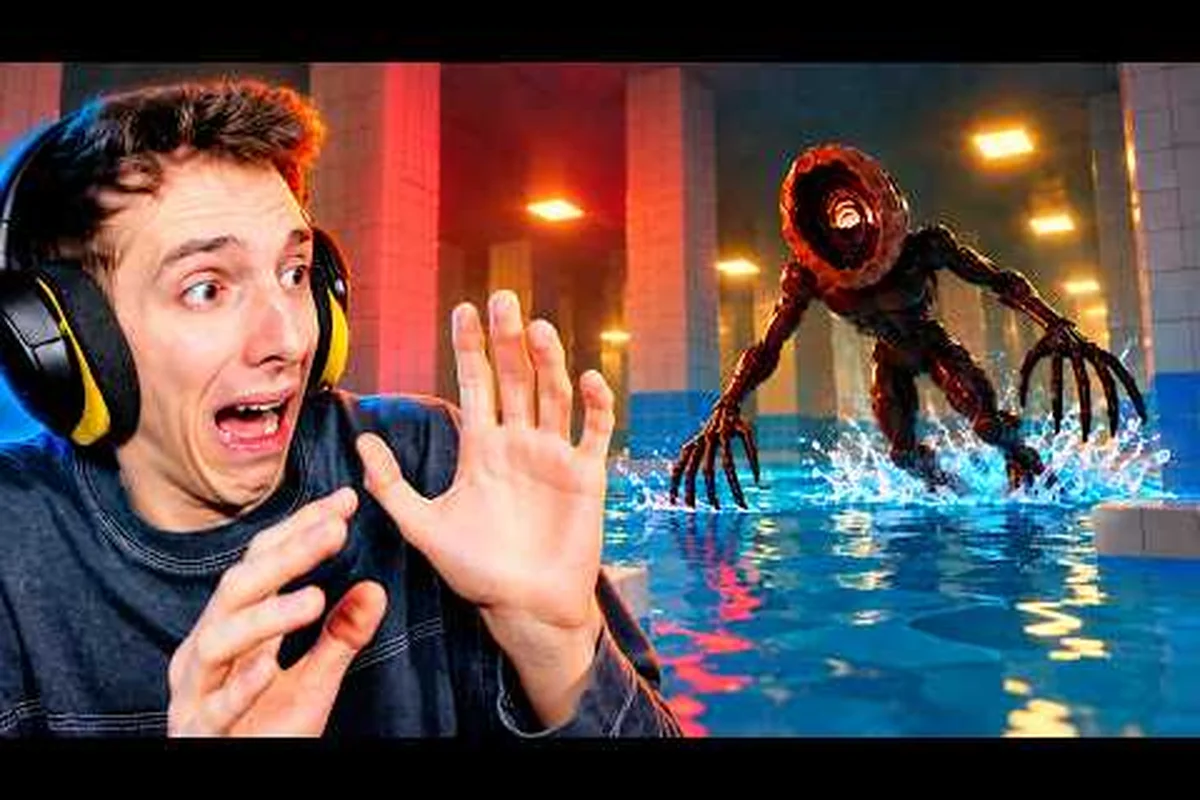
DONT SPLASH horror lore theories matter because the game uses visual repetition, water, and sound to imply a story without explaining it. The official Roblox page names the creature IT and connects the experience to Poolrooms and House of the Locust, so the strongest theories begin with those confirmed references and carefully separate evidence from speculation.
What the official DONT SPLASH description establishes
The official DONT SPLASH game page on Roblox provides the foundation for responsible lore analysis. Its description says the game draws its eerie, dreamlike mood from abandoned pool architecture and the haunted-building feel of House of the Locust, while the tagline, “DONT SPLASH, IT KNOWS,” links danger to sound. These are not merely decorative references: they establish the game’s central ingredients, including a flooded environment, an entity referred to as IT, and the idea that noise draws attention.
That distinction creates three layers of interpretation. First, the official material confirms that Poolrooms and House of the Locust influenced the presentation. Second, it confirms that IT is aware of sound or water-related disturbances. Third, it leaves open whether the setting is literally a Backrooms level, a connected fictional dimension, or a game-generated nightmare. The answer to whether DONT SPLASH is it connected to Backrooms is therefore suggestive, not proven.
| Evidence | What the source confirms | What it does not confirm |
|---|---|---|
| Official game description | Poolrooms and House of the Locust inspired the atmosphere | The game is a canonical Backrooms level |
| “DONT SPLASH, IT KNOWS” tagline | IT reacts to a meaningful disturbance | Exactly what IT hears or remembers |
| Flooded tiled corridors | Water is central to the setting and threat | Why the complex was flooded |
| Entity named IT | The creature has a deliberately vague identity | Whether IT is human, supernatural, or synthetic |
Confirmed inspiration and canonical connection are often blurred together by community theories. The official wording supports the former, while the latter would require additional evidence, such as named locations, deliberate Backrooms geography, or explicit developer statements. Until those appear, the safest description is that DONT SPLASH uses Backrooms-style liminal imagery without establishing a direct franchise relationship.
The three layers of DONT SPLASH entity lore
The lore can be separated into a physical layer, a sensory layer, and a metaphysical layer. Physically, IT occupies or patrols a flooded complex. Sensorily, it appears to notice splashes and other sounds. Metaphysically, its purpose and origin remain unexplained. That ambiguity is intentional: a creature with a clear biography would make the game feel like a story scenario, while IT feels more like a force inherent in the maze.
IT as a hunter is the least speculative interpretation. It approaches sound, forcing players to move carefully. IT as a resident is plausible because the flooded setting appears to be its natural habitat. IT as a sentience within the architecture is more ambitious, but the repeated tiles, limited lighting, and maze-like routes support the idea that the environment itself could be alive.
Why the DONT SPLASH poolrooms level feels familiar
The strongest visual clue is the blue-grey tile corridor, a recognizable marker of internet liminal-space imagery. Warm ceiling lights puncture the cold palette, still water reflects the architecture, and long passages erase any dependable sense of direction. Community footage and player experience often describe the same qualities: repeated rooms, empty hallways, dreamlike lighting, and silence interrupted by splashes. These similarities help explain the DONT SPLASH poolrooms level comparison, but resemblance alone does not establish shared authorship or lore.
Player-created environments frequently borrow the same visual grammar without claiming a direct continuity. A developer can recreate tile corridors, low ceilings, fluorescent pools, and distorted rooms while using them for a different story. For that reason, the theory that DONT SPLASH is a hidden Backrooms level should be treated as a fan connection unless the game itself confirms a named link.
| Familiar Poolrooms feature | DONT SPLASH parallel | Strength of connection |
|---|---|---|
| Tiled, low-ceiling corridors | Blue-grey tiled hallways and narrow passages | Strong visual similarity |
| Warm lamps in cold spaces | Glowing lights above flooded areas | Strong atmospheric similarity |
| Repetitive, disorienting layout | Maze-like routes with changing sightlines | Moderate similarity |
| Water as a surreal hazard | Flooded rooms and splash-triggered danger | Strong thematic similarity |
| Direct Backrooms geography | No confirmed level designation or canon reference | Unsupported conclusion |
The game’s visual argument is stronger than its geographical argument. It recreates the emotional effect of a Poolrooms level—ordinary materials made uncanny by repetition and scale—without necessarily importing Backrooms canon. The Poolrooms-inspired atmosphere breakdown explores how liminal spaces use familiar architecture to create unease rather than rely on a traditional story.
Quiet horror versus monster horror
DONT SPLASH belongs comfortably within quiet horror because its tension comes from restraint. There is no need for constant pursuit to make the setting threatening. A distant splash, an empty turning, or a change in lighting can create more fear than a visible creature. This is also why DONT SPLASH horror game aesthetic analysis often focuses on absence: empty hallways, restrained color, indistinct spaces, and the feeling that something is nearby without a clear view of it.
Community walkthroughs such as Zac Worthy’s DONT SPLASH walkthrough show the environment carrying the horror through atmosphere rather than rapid action. A separate no-commentary gameplay recording emphasizes how the silence makes the water and corridor geometry more noticeable. These are useful visual references, although no single video can establish a complete timeline or official backstory.
| Horror style | Primary tension source | DONT SPLASH evidence | Result |
|---|---|---|---|
| Quiet horror | Ambiguity, silence, anticipation | Empty corridors and restrained presentation | Central to the experience |
| Chase horror | Direct pursuit and forced movement | IT reacts to audible disturbances | Present during danger phases |
| Supernatural horror | Unexplained presence and impossible space | IT may inhabit or embody the complex | Suggested, not confirmed |
| Puzzle horror | Environmental rules and environmental clues | Water and sound determine safe behavior | Practical gameplay layer |
The most convincing interpretation combines all four without forcing one label to replace the others. DONT SPLASH quiet horror establishes the mood, sound creates the rules, the maze supplies the puzzle, and IT supplies the supernatural uncertainty. That layered design is why its lore remains compelling even without a lore document or conventional cutscene.
Where the monster comes from: leading DONT SPLASH origin theories
The question of where the monster comes from has no verified answer, so each origin theory should be graded by the evidence it uses. A theory can be emotionally convincing while remaining speculative. The most responsible analysis separates visual evidence, mechanical behavior, and narrative implication, then asks whether each category actually supports the conclusion.
| Origin theory | Supporting evidence | Contradicting or missing evidence | Confidence |
|---|---|---|---|
| IT originated in the flooded complex | Water is its habitat; sound defines its behavior | No origin event or background is shown | Plausible |
| IT escaped from another liminal space | The setting resembles Backrooms-style imagery | No portal, map, or transfer is established | Speculative |
| IT is the consciousness of the maze | Repetition and disorientation dominate the design | No direct control, voice, or environmental response | Highly speculative |
| IT is a person transformed by the space | Silence and isolation suit a corruption story | No human figure, memory, or backstory appears | Weakly supported |
| IT is a warning system for the facility | IT responds when players are loud | Its motive and relation to the facility are unexplained | Mechanically plausible |
The official phrase “IT KNOWS” may be the most revealing clue. Knowledge implies awareness, but it does not specify how IT acquires information. It could hear ordinary sound, sense vibrations through water, recognize splashes, or possess an almost supernatural awareness of the entire complex. The water-sensitive monster behavior analysis separates the creature’s confirmed behavioral triggers from the assumptions players make about its broader intelligence.
The resident, guardian, and predator interpretations
A resident theory argues that IT belongs to the complex, much as a guard occupies a building. This fits its ability to move through flooded areas and remain hidden within repetitive architecture. A guardian theory suggests IT protects something, perhaps a route, chamber, or object players have not identified. A predator theory is simpler: IT detects vulnerable targets and removes them from the maze. At present, the game supports the mechanics of a predator while leaving motive open.
The distinction matters for future updates. If IT patrols defined boundaries, the creature may be guarding a location. If it can appear anywhere water reaches, it may be inseparable from the flood. If it responds to distant splashes through the entire map, it may represent a system-wide awareness rather than a conventional body. The entity behavior and sound-based detection overview shows why observed mechanics should be kept separate from identity claims.
Why water may be a tracking medium
Water is not merely an obstacle in DONT SPLASH. It can reveal a player through reflected light, conceal movement, alter the sound of footsteps, and connect otherwise separate rooms. That makes water a plausible sensing medium. If IT detects disturbance through the flooded network, a distant splash may be less about volume than about the ripples traveling through a shared medium.
This interpretation also explains the title. Players are told not to splash because splash propagation is the danger signal. It does not confirm that IT is made of water, only that water carries information. A solid creature, a supernatural presence, or even a remote sensing phenomenon could use the same cue. This uncertainty is useful because it preserves the horror: the player cannot know whether avoiding splashes is enough or merely delays discovery.
Reading clues in the horror game aesthetic
Aesthetic analysis works best when it examines how the game communicates rules. Color, repetition, lighting, and empty space are not separate visual effects; together they create expectations that the monster can break. The official Poolrooms and House of the Locust references provide a clear aesthetic baseline, while the game adds a water-centered survival mechanic and the unexplained identity of IT.
| Visual element | Apparent meaning | Possible hidden clue | Confidence |
|---|---|---|---|
| Blue-grey tiles | Artificial, clinical, nonresidential space | The complex may be institutional or unreal | Moderate |
| Warm ceiling lamps | Artificial comfort in an inhospitable place | Safety exists only in fragments | Moderate |
| Reflective standing water | A connected environmental layer | Water may transmit information | Moderate to high |
| Empty identical rooms | Repetition without human activity | The maze could be generated or cyclical | Moderate |
| Heavy contrast around corners | Uncertainty beyond the visible frame | IT may occupy unseen spaces | Low to moderate |
| Unnamed “pool” area | A location that resembles a central pool | Water could connect several routes | Speculative |
The House of the Locust comparison adds another interpretive layer because it suggests that empty domestic or institutional spaces can become threatening without direct confrontation. In DONT SPLASH, the abandonment is not merely visual; it is functional. Empty halls leave nowhere to hide from a sound-sensitive entity. The absence of people becomes evidence that IT has already made the space dangerous.
The sound design and hidden-lore analysis goes deeper into how silence, footsteps, and splashes shape interpretation. This is important because sound can reveal both the monster and the player. A loud moment does more than endanger the run; it narrates the failure of careful movement, turning an audiovisual inconvenience into a piece of entity lore.
Interpreting the tagline without overclaiming it
“DONT SPLASH, IT KNOWS” can be read on three levels. The practical level warns players about a mechanic. The atmospheric level says the player is being observed. The metaphysical level suggests that IT possesses awareness beyond normal perception. Only the first level is directly supported by the official description and observable gameplay. The others remain valid readings because silence and restriction naturally produce paranoia.
Language also matters. The game does not call the creature “the monster” on the official page; it calls it IT. That capitalizes the word and removes a descriptive identity. The player learns what IT does before learning what IT is, which reinforces the idea that the entity may be less a character than a law inside the setting.
The strongest DONT SPLASH horror lore theories compared
A good theory explains more than one detail, respects the game’s confirmed elements, and leaves room for future information. The table below ranks five common interpretations by explanatory power, not by whether they are canon. This makes the comparison useful for readers deciding which ideas deserve further attention without mistaking fan synthesis for official story information.
| Theory | Explains water | Explains IT | Explains maze | Overall strength |
|---|---|---|---|---|
| IT is the complex’s sound-hunting inhabitant | Strong | Strong | Moderate | Best-supported interpretation |
| IT is a distant predator attracted to noise | Strong | Strong | Weak | Mechanically sound, narratively limited |
| The flood is IT’s sensing network | Very strong | Strong | Strong | Elegant but unconfirmed |
| The complex is a linked Backrooms space | Moderate | Moderate | Moderate | Compelling parallel, weak evidence |
| IT is a failed human explorer | Weak | Weak | Moderate | More symbolism than evidence |
| The pool is a gateway to another level | Moderate | Moderate | Strong | Creative, but not visually explicit |
The flood-as-sensory-network theory is especially useful because it links multiple parts of the experience into one model. Water explains how sound travels, IT becomes a hunter adapted to that medium, and the maze explains why escaping requires leaving a connected aquatic system. Its weakness is equally important: there is no direct evidence that IT perceives the entire flood at once.
By comparison, the Backrooms theory explains the visual language but says less about the title and water mechanic. The official inspiration makes it a reasonable lens, yet naming Poolrooms does not make the game a formal entry in the Backrooms canon. A useful analysis of whether DONT SPLASH is it connected to Backrooms should therefore ask not only whether the rooms look similar, but also whether the story adds anything beyond the borrowed atmosphere.
A framework for judging new clues
Future evidence can be sorted into four categories. Behavioral evidence includes IT’s response to splashes, doors, hiding, and environmental objects. Spatial evidence includes maps, landmarks, repeated rooms, and unusual transitions. Narrative evidence includes text, dialogue, symbols, or environmental storytelling. Developer evidence includes official statements or patch notes. The strongest confirmation would combine more than one category, especially developer evidence paired with in-game details.
| Clue type | Example | Theoretical value | Verification level |
|---|---|---|---|
| Repeated audio cue | A splash plays before IT appears | Suggests shared detection system | Direct observation |
| Unique architecture | A room differs from normal tiles | May mark a special chamber | Direct observation |
| Text fragment | A warning references a place or entity | May establish a history | Direct observation |
| Official statement | Developer names the setting | Can establish canon | Highest authority |
| Fan edit or remix | Creator connects scenes | May inspire theory but not confirm it | Community evidence |
Community reports remain valuable because they can surface patterns that official material omits. The problem arises when an interpretation becomes repeated until players mistake repetition for confirmation. Community consensus can measure how popular a theory is, but it cannot establish what the developers intended. Keeping those categories separate preserves both the enjoyment of speculation and the integrity of the lore discussion.
Practical conclusions from the DONT SPLASH entity lore
The lore theories become useful during play because they shape how players read the environment. If water carries sound, every puddle is a potential information route. If IT is resident rather than a visitor, the maze may be its territory rather than a temporary hunting ground. If the architecture is cyclical, a distant landmark may indicate a loop rather than progress. These interpretations encourage observation without requiring players to risk a run for lore that the game does not explain.
A useful observation checklist during a run can focus on moments that do not interrupt ordinary progress. Players can record which rooms contain standing water, whether sounds seem to travel between corridors, if IT follows a fixed route, and whether lights or reflections change before an encounter. Comparing those details across separate attempts is more reliable than trusting a single frightening memory.
| Observation | Possible interpretation | Best way to test it |
|---|---|---|
| IT reacts only after water noise | Water-mediated detection | Compare identical rooms with different puddle placements |
| Doors muffle or amplify sound | Acoustic rule tied to spaces | Test the same route with open and closed paths |
| The route repeats after several turns | Cyclical map structure | Note landmarks and turns across attempts |
| IT appears near dry rooms | Patrol or boundary behavior | Record encounter locations on a rough map |
| No sound is required for an encounter | Alternative detection or scripted event | Compare quiet runs with visibly identical routes |
These tests do not require treating every anomaly as a secret. Some behaviors may be procedural, some may be level-specific, and some may be presentation choices. The line-of-sight and quiet-movement analysis is especially relevant here because it separates visual detection from audio detection and helps prevent players from assuming that darkness alone guarantees safety.
What can be called confirmed lore today?
Confirmed lore is limited. The official page establishes the Poolrooms and House of the Locust inspirations, identifies the creature as IT, and frames noise as the central danger. Gameplay demonstrates a flooded, maze-like environment in which careful movement matters. Everything beyond that—including IT’s origin, the nature of the complex, or a connection to the Backrooms—remains a theory unless supported by additional official material.
That does not make the theories worthless. Interpretive confidence can range from observable mechanics to symbolic readings, and confidence should decline as a claim depends more heavily on implication. A theory that IT is attracted to splashes has strong mechanical support. One that IT guards a hidden chamber has moderate support if unusual architecture accompanies certain encounters. One that the game is secretly a canonical Backrooms level has appealing visual support but little narrative proof.
The most responsible conclusion is therefore dual: DONT SPLASH clearly participates in the tradition of Backrooms and Poolrooms-inspired liminal horror, while its own entity lore remains deliberately unresolved. IT may be a resident, a guardian, a predator, or something without a stable physical identity. The water, quiet rooms, and creature behavior make those interpretations feel coherent, but coherence is not the same as confirmation.
Frequently Asked Questions
Is DONT SPLASH officially connected to the Backrooms?
No official Backrooms connection has been confirmed. The official game page states that the game draws inspiration from the same eerie, watery look found in Poolrooms-style spaces and the haunted-feeling mood of House of the Locust, which supports a visual and thematic comparison. Similar tiled corridors and liminal spaces make the idea appealing, but resemblance alone cannot establish shared canon, geography, or narrative continuity in the Backrooms.
Is the DONT SPLASH poolrooms level a direct copy of the Backrooms?
It appears influenced by familiar Poolrooms imagery rather than a direct copy. The game uses tiled corridors, warm lights over cold spaces, standing water, and repeated architecture to create a liminal maze. Its stronger original element is the sound-sensitive entity and the danger associated with splashing, which gives the flooded setting a specific mechanical role beyond decorative similarity.
Where does the monster in DONT SPLASH come from?
Its origin remains unknown. The most grounded theory is that IT inhabits the flooded complex and detects disturbances, while the more speculative suggestions portray it as the maze’s consciousness, a guardian, or a being from another liminal space. The official material names the creature IT but provides no origin story, so any definitive claim would exceed the available evidence.
Does IT see the player or only hear water?
The clearest supported mechanic is that sound matters, especially splashing, although the exact detection system is not fully explained. Darkness can reduce visibility, but it does not automatically make a player safe if noise travels through water or corridors. Careful movement, environmental observation, and awareness of nearby IT encounters provide more reliable protection than darkness alone.
Why is DONT SPLASH considered quiet horror?
Quiet horror creates tension through uncertainty, silence, and restrained visuals rather than constant action. DONT SPLASH emphasizes empty corridors, still water, dim lighting, and the possibility that something is nearby. IT’s response to disturbances adds a pursuit element, but the slow, liminal atmosphere remains the foundation of the experience and the source of its strongest lore imagery.