
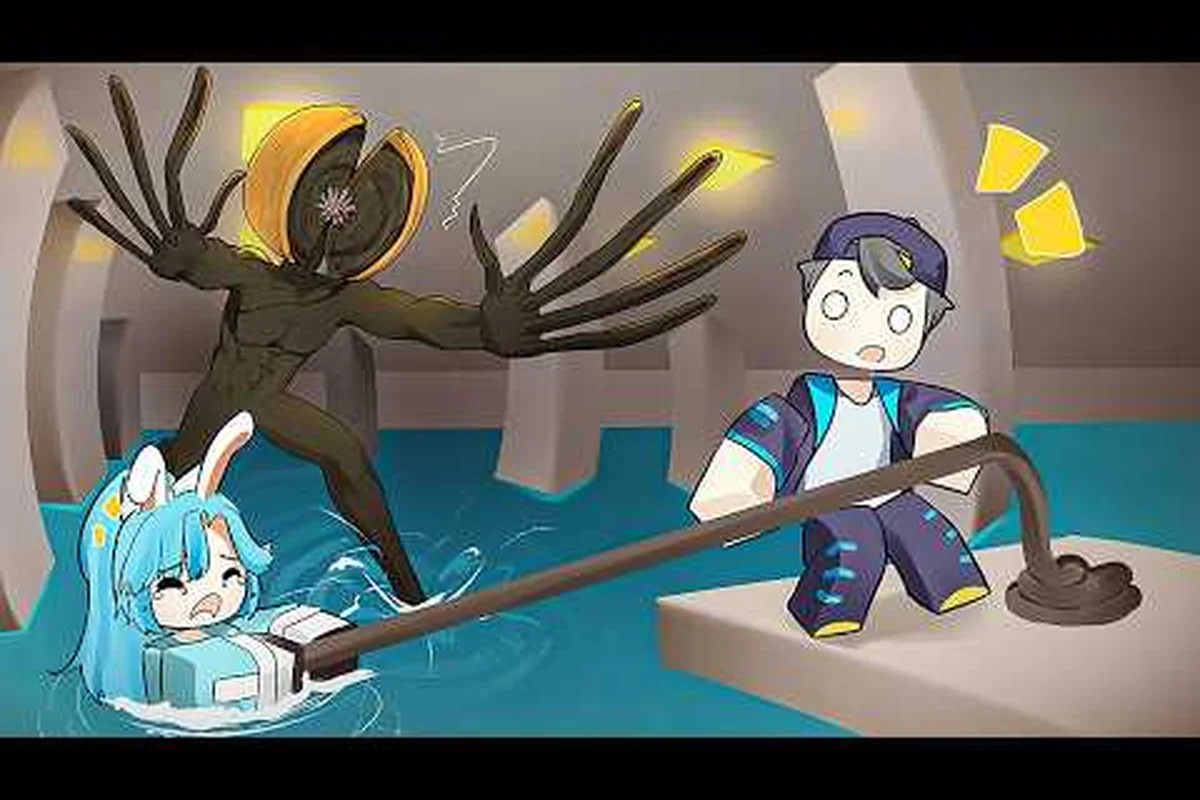
The Dont Splash monster is blind and detects players through sound, so each footstep, dash, or dropped object can reveal your position. Its hearing triggers a patrol shift toward the last noise, while repeated splashes may cause it to commit to the search area longer. Staying on hard surfaces, avoiding water, and throwing distractions into a separate corridor can break that tracking pattern before the monster closes in.
How the DONT SPLASH Monster Finds You
The dont splash water sensitive monster is called IT, and it does not need a clear view of your avatar to locate you. According to the official DONT SPLASH game page, IT navigates through splash detection rather than sight, making every water impact a potential alarm. The important distinction is that IT responds to a sound event, not necessarily to the exact position of your body after the splash.
That distinction changes how you survive. Running away immediately may leave the creature traveling toward a noisy landing point, while staying near that same point can place you directly in its path. A successful escape depends on controlling where the sound occurs, reading the creature’s approach, and creating a second noise source in a safer direction.
What triggers IT
The main trigger is water contact. Falling from a platform, clipping a water surface during a jump, or throwing an object that hits water can all produce a splash. Dry landings are quieter and therefore safer, although the creature may still be close enough to intercept your next move.
| Player action | Likely result | Immediate response |
|---|---|---|
| Land on a dry platform | No water splash detected | Pause briefly and listen |
| Fall into water | Strong sound event | Move away from the entry point |
| Clip water while jumping | Splash can occur mid-route | Do not keep moving through the same lane |
| Throw a pebble into distant water | IT may investigate that location | Use the distraction before crossing |
| Move near the water’s edge | Greater risk of accidental contact | Keep extra distance from the surface |
This table reflects the sound-based behavior described on the official game page and demonstrated in community walkthroughs. It does not mean that every noise is identical. A full fall into water, a brief midair clip, and an object striking the surface may produce different levels of danger, but all three fall within the core detection loop.
The creature cannot see you
IT is blind, which means hiding behind an obstacle does not directly solve the problem. Your avatar’s silhouette is irrelevant if the creature has a sound target to follow. This makes understanding dont splash monster behavior different from a typical chase game: visual cover is less useful than controlling noise and distance.
The sound may lead IT to the location of a splash rather than continuously tracking your movement afterward. That opens a useful tactical window. If you create noise away from your intended path, then remain quiet while IT commits to the false location, you can pass through the area that IT has just abandoned.
DONT SPLASH Monster Mechanics and Patrol Patterns
The central rule of dont splash monster mechanics is a simple cause-and-effect chain: water creates a sound, the sound gives IT a destination, and IT closes toward that destination. Once there, the creature may search the area before drifting back toward patrol. Players who understand each step can make deliberate decisions rather than reacting only when IT appears nearby.
The detection and charge cycle
Community footage shows a consistent behavioral loop. IT patrols below the surface with little warning, reacts when a splash occurs, and charges toward the affected area. Players report that audio cues can reveal its distance before the chase becomes visible, although exact timing may vary by platform or game version.
| Stage | IT’s behavior | Player advantage |
|---|---|---|
| Patrol | IT moves below the water | Pick a quiet route while it is distant |
| Alert | A splash produces a sound event | Identify the direction of the new noise |
| Charge | IT heads toward the splash zone | Avoid crossing that zone |
| Search | IT checks around the target area | Move only while it remains committed |
| Reset | IT returns toward patrol | Resume when the route is clear |
The charge is the most dangerous phase because the creature can cover open ground quickly. A chase is also harder to control when the player makes additional splashes, because each new sound can redirect or intensify its response. A controlled decoy is generally safer than a chain of panicked noises.
Water contact, not water visibility
Being near a pool does not automatically expose you. The danger comes from contact that creates a detectable splash. A dry platform beside the water may be safe, but a low jump that barely touches the surface can still be enough to send IT toward the route.
The walkthrough demonstrating the creature’s patrol behavior shows why headphones can be useful: the audio warning may arrive before IT visibly commits to the chase. Listen for movement beneath or beyond the safe platform, then reconsider any jump that would cross water.
Pebbles as positional decoys
A pebble thrown into distant water can pull IT away from a crossing the player needs to make. The important technique is not merely throwing an object, but placing the resulting sound where you want the creature to go. A decoy behind you is useful only when your escape route runs in the opposite direction.
Recorded community gameplay demonstrates the pebble lure redirecting IT toward a separate pool. This makes it a practical tool for dont splash how to hide from monster situations, although it is not a permanent invisibility mechanic. IT can still catch you if your path passes too close to the decoy or if you make another splash afterward.
Avoiding the Monster Without Creating a Second Splash
The safest route through DONT SPLASH is not always the shortest one. It is the route that avoids water contact and keeps enough space between you and IT for the creature to finish investigating an old noise. The overview of the blind creature and its sound-based response provides useful context for the larger patrol system, while the practical concern here is preserving a dry escape path.
Plan the next landing first
Before committing to a jump, identify three things: the landing surface, any water crossed in flight, and the direction from which IT may approach. If the landing is dry but the route crosses a pool, wait for IT to move. If the jump must touch water, consider another platform or use a pebble to create a safer sound elsewhere.
A practical dry-route check looks like this: first, identify the exact platform where the avatar will land, then trace the jump arc and note every pool, puddle, or water edge it might clip. If the landing point is dry but the route passes through water, wait for IT to move before jumping. When the jump must touch water, choose another platform or use a pebble to create a safer sound elsewhere, because a splash can alert the water-sensitive monster even if the avatar reaches solid ground afterward.
-
Can you land on a solid platform rather than a water surface?
-
Does the jump path pass through any pool, even briefly?
-
Is there room to move away after landing?
-
Can you see or hear IT before the jump begins?
-
Do you have a pebble available for a deliberate diversion?
-
If IT charges, is there a second platform rather than water to reach?
This method prevents the most common mistake: treating a dry final landing as safe even though the avatar clipped water during the jump. For more examples of borderline interactions, what counts as a splash in DONT SPLASH distinguishes falls, midair contact, and other water-triggering situations.
Break line of sight, then break the route
Since IT cannot see you, running behind scenery does not guarantee safety. The useful break occurs when your position and the next sound are separated. Stop after a dry landing, listen, and only then choose a new platform. A silent pause can be safer than a fast route that clips the water.
| Situation | Better response | Why it works |
|---|---|---|
| IT is moving toward a past splash | Cross behind its route | It remains committed to the old sound |
| IT is searching near your platform | Wait on dry ground | It may inspect the noise source |
| You must cross water | Lure IT elsewhere first | The charge goes to the decoy |
| You accidentally splash | Move away from the entry point | You do not remain inside the target zone |
| Headphones reveal nearby movement | Delay the jump | IT has not yet reached your route |
Never keep moving after an accidental splash
An accidental entry can still be survivable. The immediate mistake is to continue swimming or flailing through the same area, creating repeated noise and making your position easier to predict. Move decisively toward the nearest dry exit, stay on solid ground after landing, and let IT investigate the original splash.
This is where dont splash how to avoid the monster becomes more than route planning. It is also about damage control. One noisy event can be redirected with distance and silence; several events in quick succession can pull IT from multiple directions and leave you with no quiet platform to use.
How to Lure IT and Keep a Safe Distance
A pebble decoy works best when used before IT reaches your route. The desired sequence is simple: identify the target area, throw into a separate pool, wait for the creature to commit, and cross while it remains away. If you throw too late or too close, you may create a new noise source beside your own path.
A reliable diversion sequence
-
Stop on a dry platform and confirm the next route.
-
Locate a separate water target that is not required for your escape.
-
Throw the pebble into that target and listen for the resulting splash.
-
Watch for IT’s response so you know whether the creature committed.
-
Cross during the charge, keeping your movements quiet and controlled.
-
Move beyond the decoy zone before touching water again.
This sequence is especially effective because it changes the creature’s goal without requiring combat. Players cannot kill IT, so a decoy is a defensive action rather than an offensive one. The wider patrol and distraction options are discussed in how to distract the creature.
Choose decoy locations carefully
A good decoy is distant, not merely behind you. IT needs enough time to travel toward the sound while you clear the area. A pebble landing close to your current platform may draw IT straight into your escape route, which is worse than not throwing it at all.
| Decoy placement | Likely result | Suitability |
|---|---|---|
| Far across the intended path | Pulls IT away from the crossing | Best |
| Behind the player with a wide dry exit | Creates time to move | Good |
| Directly beside the player | May expose the player during the charge | Risky |
| In the only pool the player needs | Sends IT toward the planned route | Poor |
| Far enough away to mask the approach | Supports a quiet crossing | Strong |
Wait for the search, then move
Once IT reaches a splash, do not assume the danger has instantly passed. Community reports and observed gameplay indicate that the creature can check the area before returning to patrol. Moving immediately after it arrives may carry you through the same space it is searching.
Wait until IT travels beyond your crossing, then move through a dry section. If it changes direction, stop and listen. The objective is not to outrun the creature in a straight sprint; it is to let the search phase end and the patrol phase begin.
Reading Audio Cues and Reacting to the Chase
Headphones improve the information available during a pursuit because the water-sensitive monster relies on sound. The visual scene can appear calm while IT is moving below the surface, but audio may reveal its approach. Community gameplay clips and player reports consistently treat the creature’s movement as an important warning before the chase becomes obvious.
What to listen for
The most useful cue is a change in the soundscape around the water. Exact audio descriptions may differ between devices, so focus on a change rather than expecting one exact note. A distant splash, a rumble, or movement under the surface can indicate that IT has shifted state.
| Audio cue | Likely interpretation | Action |
|---|---|---|
| Distant water impact | IT may have reached a splash zone | Check whether the sound came from your route |
| Low movement beneath platforms | IT is nearby or changing direction | Pause before crossing |
| Sudden heavier movement | A charge may be starting | Move only along a dry route |
| Sound fades or becomes distant | IT is moving away | Continue through a planned path |
| New splash behind you | IT has a fresh target | Avoid returning to the old area |
Audio should support visual checks, not replace them, because players can still misjudge distance while wearing headphones at low volume or when platform effects mask a splash. Try a short listening interval, then pause to confirm the platform layout and the monster’s position visually before moving. If the sound fades, that may mean IT is moving away; if heavier movement or a new splash occurs, treat the area as active and choose a dry route rather than crossing the water zone.
Jump only when the route is clear
The dangerous moment is often the instant after a dry run. A player hears IT moving away, commits to a large jump, clips the pool, and creates a new target directly in front of the creature. Pause at the edge, verify the landing, and use a decoy if the path is unavoidable.
This is the central answer to dont splash how the monster works: IT reacts to a defined event, follows the resulting target, and then searches. It is not constantly aware of every silent movement. Your objective is to prevent the event or redirect the target, not to win a visibility contest.
Practical Rules for Surviving Every Water Section
Surviving IT comes down to avoiding accidental contact, interpreting cues, and controlling the direction of every intentional splash. These rules summarize the behavior without pretending that exact distances or reaction times are fixed, because community observations indicate that timing may vary by platform and version.
The complete survival checklist
Before every obstacle with nearby water, confirm the following: treat even a partial water contact as a valid target because IT detects sound and can begin a search after one splash. For example, if a jump path clips a pool for half a second, do not assume you are safe; listen for IT’s approach, keep moving toward a dry platform, and use a pebble away from your exit route only when the crossing cannot be delayed.
-
Dry contact: Your next landing surface is not water.
-
Clean flight: Your jump path does not clip a pool, even briefly.
-
Quiet pause: You have listened long enough to judge IT’s direction.
-
Clear landing: There is space to move after landing.
-
Prepared decoy: A pebble is available if a crossing cannot be delayed.
-
Exit route: The nearest dry platform does not require another splash.
| Rule | Reason |
|---|---|
| Never assume IT can see you | It detects sound, so visual hiding alone is unreliable |
| Treat every water contact as an alarm | A brief clip can still create a valid target |
| Keep moving after a splash | Remaining nearby keeps you inside the danger zone |
| Use decoys away from the exit | A close pebble may pull IT into your route |
| Wait through the search phase | IT can inspect the target after arriving |
| Prioritize dry platforms | They reduce both detection and escape risk |
| Listen before jumping | Audio can warn you before a visible charge |
Avoid repeated mistakes
The most expensive mistake is forcing a crossing while IT is close. Players often interpret its temporary silence as safety, even though the creature may be approaching from a different direction. Another common error is using a pebble without listening for the resulting response. The thrown object only helps if the new sound actually pulls IT away from the intended path.
The broader obby route and jumping guide can help with platform familiarity, but the crucial survival skill is deciding whether a jump is necessary right now. Waiting is often the most efficient route because it lets you learn the level without adding noise.
What you cannot do
There is no conventional combat solution. Players cannot kill IT, stun it permanently, or force it to ignore a sound. Your available defenses are limited but useful: avoid the splash, change your timing, redirect the creature with a pebble, and maintain distance until its attention shifts.
Understanding the limitation is important because chasing IT can create more noise than waiting. If it moves away after investigating a decoy, do not run past the same water merely to confirm that it is gone. Let the patrol reset, then use the quieter opening.
Frequently Asked Questions
Can the DONT SPLASH monster see players?
No. IT is blind and relies on splash sounds, so hiding behind scenery does not guarantee safety. The most reliable approach is to avoid water contact, create a deliberate decoy when necessary, and move away from the location of every splash you produce.
What makes the monster chase a player in DONT SPLASH?
IT reacts to water-related sounds, including falling into a pool, clipping water during a jump, or an object striking the surface. It travels toward the sound zone rather than requiring a clear view of the player, so any splash can redirect its path. For example, a jump that clips a puddle may draw IT away from a dry route, while a pebble landing in a separate pool can pull its attention elsewhere. Understanding this sound-tracking behavior is essential for learning how the DONT SPLASH monster finds you and how to avoid it.
Can you kill the monster in DONT SPLASH?
No. IT cannot be defeated through normal combat, so encountering the DONT SPLASH monster means avoiding confrontation entirely. Keep every route dry, wait for IT to investigate another splash, and use a pebble to redirect the water-sensitive monster toward a separate pool before crossing; otherwise, a single accidental splash can pull it onto your position.
Is throwing a pebble safe for every player?
A pebble is safest when it lands far from your escape route. If it creates a splash beside you, it may pull IT directly toward you. Listen for the response, confirm that IT commits to the decoy, and cross only while that area remains clear.