
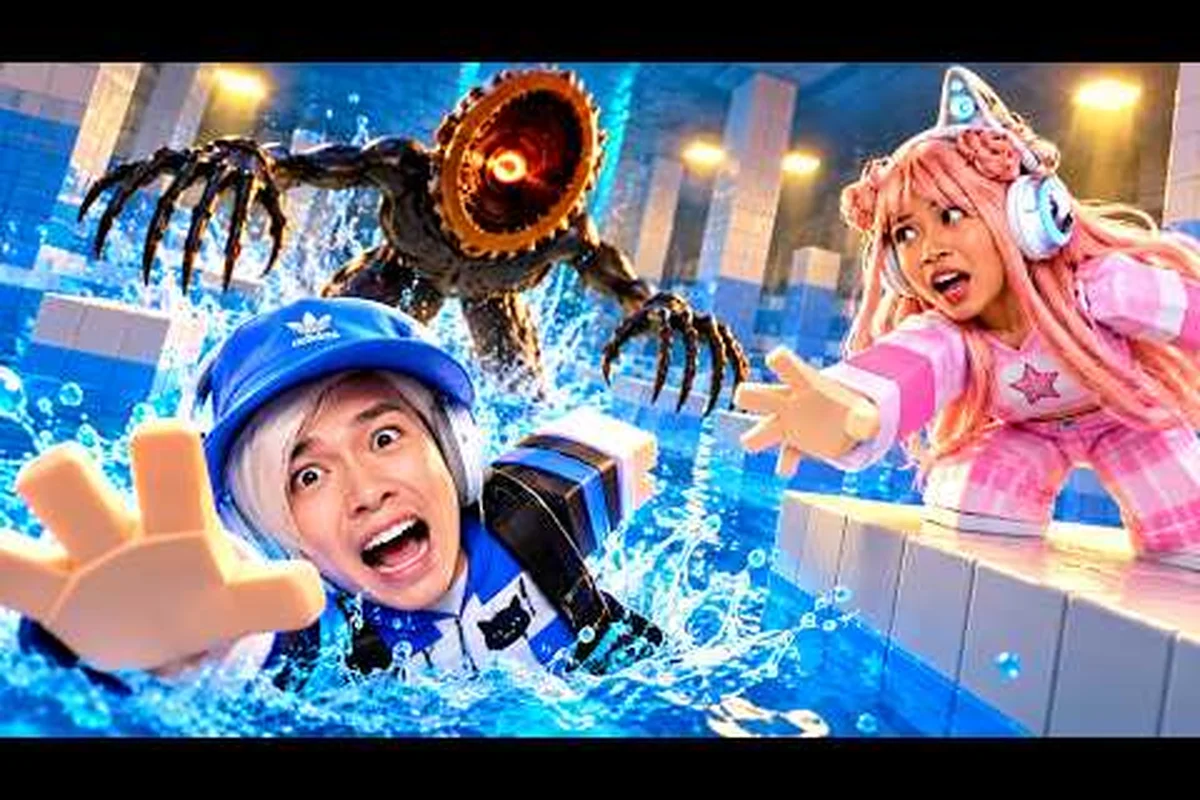
DONT SPLASH turns teamwork into a noise-control problem: every splash can summon the creature, so a successful squad must communicate, move carefully, and rescue fallen teammates without turning one mistake into a chain reaction. This dont splash how to play with friends guide explains the rules, routes, and difficulty choices that make 10-player runs practical instead of chaotic.
DONT SPLASH How to Play With Friends: Roles and Objectives
The goal in DONT SPLASH is not simply to reach the exit. According to the official DONT SPLASH game page, players cross platforms above dark water while a blind monster hunts by sound. Your squad must open both valves in the maintenance lock, then reach the high exit before the rising water removes the remaining route.
The official listing describes the game as a flooded pool maze inspired by unsettling poolrooms and the House of the Locust. For cooperative play, that means navigation cues matter more than combat. Yellow platforms and black wall arrows point toward the route, while every jump, splash, pebble throw, and rescued teammate can influence where the monster investigates.
Before gathering a group, review the DONT SPLASH beginner guide for the basic escape loop. Once players understand the objective, assign a few simple roles so the group does not bunch together or compete for the same safe position.
| Team role | Main responsibility | Best action |
|---|---|---|
| Route caller | Reads yellow platforms and black arrows | Calls landmarks before the group moves |
| Splash monitor | Watches edges and water hazards | Calls out risky landings |
| Rescue coordinator | Tracks downed teammates | Organizes safe recovery attempts |
| Pebble handler | Creates controlled distractions | Throws into water away from teammates |
| Exit caller | Confirms valve and exit status | Prevents premature returns to the high exit |
These roles are flexible. Two reliable callers may outperform ten players shouting at once. The important principle is that one voice leads movement, while another watches hazards. Assign the roles before starting and change them only when the squad naturally stops functioning.
A Simple Ten-Player Formation
For a full squad, divide players into two groups of five. The front group advances along dry platforms and places visible route markers. The second group remains at least one safe landing behind, where it can respond if the first group needs help.
Avoid a ten-player blob. It increases splash exposure, makes instructions harder to hear, and gives the creature several sound sources at once. A staggered formation also prevents a single missed jump from knocking the entire team into the water.
One-player lookahead is better than simultaneous experimentation. When an uncertain jump appears, send one player across, confirm the landing, and have the remaining squad wait. A successful scout creates a route for everyone; a failed scout costs one life rather than the whole group.
DONT SPLASH Difficulty Guide for Cooperative Runs
Difficulty changes how demanding the escape feels, but the basic noise rule remains central. The dont splash difficulty guide should help you choose a setting that rewards coordination without making every minor mistake fatal. Players who are new to the game generally benefit from practicing the route before increasing the pressure.
This comparison evaluates how each dont splash difficulty setting changes squad behavior, rather than implying that the modes use unsupported numerical modifiers. In practical terms, easy mode favors slow group movement, normal mode depends on short route calls and checkpoint control, and hard mode tests fast, precise rotations. For friends learning the valve route, choose the level that fits their communication habits: too much noise can turn a minor landing error into a split-up, while disciplined callouts help the squad rescue a fallen teammate without losing momentum.
| Difficulty | Recommended group behavior | Main risk | Best use |
|---|---|---|---|
| Easy | Slow, tightly grouped movement | Slower clear time | Learning the full valve route |
| Normal | Small groups with clear checkpoints | Split-up during rescues | Balanced cooperative runs |
| Hard | One scout, minimal talking, fast rotations | Cascading mistakes | Skilled, practiced squads |
On dont splash easy mode, pause before each landing and give new players time to inspect the jump. The reward for caution is a lower-pressure environment in which teammates can learn the visual language of the level. Use this setting for a first cooperative session or when several players have never finished the game.
On dont splash normal mode, the game becomes a good default for a coordinated team. It preserves tension while giving the squad enough room to recover from one bad landing. Establish a rule that the route caller alone authorizes the next jump, and designate a rescue coordinator who can override the group when someone falls.
On dont splash hard mode, every routine mistake becomes more expensive. Use rehearsed checkpoints, minimize conversation during crossings, and avoid sending multiple players toward a platform that only one person has tested. Experienced squads can use a one-at-a-time crossing rule for rotating bridges, narrow platforms, and uncertain jumps.
| Difficulty | Communication | Movement pace | Rescue priority |
|---|---|---|---|
| Easy | Frequent explanations | Very slow and deliberate | Immediate after any fall |
| Normal | Short callouts | Moderate | After route leader confirms safety |
| Hard | Minimal, precise calls | Fast but controlled | Only with a clear decoy window |
Difficulty should match coordination quality, not just individual game knowledge. A loud, chaotic squad belongs on easy mode because slow, tightly grouped movement gives players time to inspect each valve jump and recover a fallen teammate. Conversely, an experienced group that understands the map can use hard mode to test cleaner execution through one-at-a-time crossings, precise checkpoint calls, and fast rotations. For example, if friends repeatedly talk over each other on a narrow platform, normal mode’s moderate pace is safer than hard mode’s minimal, precise calls.
Noise Control and Rescue Rules for DONT SPLASH
The creature reacts to splash sounds rather than player vision, making noise control the most important cooperative rule. A squad should treat water as an alarm system. Touching it directly, jumping through it, or pushing a teammate into it can redirect the monster away from the intended route, but it also announces exactly where the squad is working.
This mechanic makes the game suitable for deliberate rescues. If a teammate falls, other players should not rush into the same water. First, identify where the monster is moving. Then create a directional decoy on the opposite side and guide the survivor toward a platform that does not require another splash.
According to community tips, thrown pebbles can serve as active decoys, while remembered dry routes are more dependable than expensive gear. A pebble works best when the throwing angle is clear and the landing point is away from the group. Random throws create a second noise event rather than a reliable diversion.
Use a Three-Step Rescue Protocol
A three-step rescue protocol keeps panicked players from turning one fall into a group wipe: designate a target, create a distraction, then extract the survivor along the safest route. In Don’t Splash, every splash can alert the monster, so one teammate’s mistake should trigger a coordinated response rather than several players rushing into the same water. For example, if one player falls near a platform edge, the remaining group can mark that position and throw a pebble in the opposite direction before guiding the fallen player toward cover. The protocol is most useful in co-op runs where players may have different route knowledge, experience levels, or perspectives on the monster’s location.
| Step | Action | Purpose |
|---|---|---|
| 1. Mark | Point out the fallen player and nearest safe platform | Establishes a clear target |
| 2. Distract | Throw a pebble away from the recovery route | Draws attention elsewhere |
| 3. Extract | Guide the survivor without entering the same water | Limits additional splash sounds |
If extraction is unsafe, mark the location and continue the main objective. Rescuing one player by sacrificing five is rarely a good group decision. The same route knowledge that helps a veteran escape also helps the squad decide when a rescue is worth attempting.
Water contact is not the only sound source. A successful extraction ends with a deliberate pause: after rescuing a teammate, the group should stop moving for a few seconds and listen for the monster, since falling objects, missed jumps, crowded landings, and thrown pebbles can also create suspicious sounds. For example, if the survivor lands on a platform while another player tosses a pebble as a distraction, the first noise may draw the monster away, but the second can expose the squad’s position. Staying still briefly helps friends distinguish a genuine pursuit from unrelated environmental cues before choosing the next cover route.
When the Squad Should Abort a Rescue
Abort when the fallen player is beneath a heavily splashed section, the monster is already circling the target, or the route to the exit is about to close. These conditions make a direct rescue more likely to produce multiple casualties. Instead, throw a pebble, mark the position, and finish the valve objective.
A fallback strategy protects the group’s main chance of winning. If the lost player respawns before the final exit, the remaining players can meet them there. If respawning sends them to a separate route, the squad should follow the official yellow-platform and black-arrow cues rather than attempting an improvised shortcut.
DONT SPLASH How to Play With Friends: Route and Valve Strategy
The intended escape route described by a verified gameplay walkthrough is straightforward once the map language becomes familiar: follow yellow platforms and black wall arrows, cross rotating bridge planks, open both valves in the maintenance lock, and climb to the high exit before the water rises. The difficulty for friends lies in recognizing these cues and keeping the group synchronized.
Use three route checkpoints: the first yellow-platform section, the rotating bridge, and the maintenance lock. The squad does not need to reach each checkpoint together if a safe holding area exists, but nobody should continue past it until the route caller confirms that everyone has arrived.
| Route segment | Group approach | Hazard control |
|---|---|---|
| Yellow platforms | Move in short lines | Test uncertain gaps with one player |
| Rotating bridge planks | Wait for a safe alignment | Keep a steady pace to avoid bunching |
| Maintenance lock | Search in assigned pairs | Avoid repeated splashing near the valves |
| High exit | Gather only after both valves open | Confirm the rising-water route remains usable |
The DONT SPLASH obby guide can help players sharpen their jumping and route-reading fundamentals. In a group, those skills must be adapted. A technically perfect jump still fails the team if a dozen avatars land together, make noise, or block the next platform.
Split the Valve Search
When the squad reaches the maintenance lock, split into two pairs. One pair searches the left side while the other checks the right, but both groups stay close enough to hear the route call. Each pair should report valve locations rather than opening them immediately.
Opening both valves at the same time may create confusion, particularly if one player cannot see the other valve. A reliable sequence is to have each pair confirm its own valve location, then designate one pair to open the first valve while the other pair checks the route from a different angle. This keeps the maintenance-lock search organized and prevents teammates from rushing toward an exit that is not yet ready.
-
Pair A locates its valve.
-
Pair B confirms the second location from a different angle.
-
Pair A opens the first valve.
-
Both pairs regroup at a marked safe platform.
-
Pair B opens the second valve.
-
The route caller orders everyone toward the high exit.
This process adds only a few seconds and prevents the squad from rushing to an exit that is not yet ready. Once both valves are open, the team should move as a compact group, because the rising water may erase low routes and leave only one dependable path.
Keep the Final Climb Together
The final climb works best when the squad avoids sudden sprints. Use yellow platforms and black arrows to stay on the intended path, and let the rear player report stragglers. If someone falls near the exit, the group should assess the current water level before creating a decoy.
Community reports indicate that retries are normal because progress is largely knowledge-based. The first failed run teaches the route; the second reveals whether the squad communicates well. A polished tips guide for beginners can help the team recognize common mistakes after each attempt.
Ten-Player Coordination Checklist and Common Mistakes
A ten-player group produces more chances for good coordination and more chances for conflicting instructions. Use a short checklist before each major section. The goal is not to eliminate conversation, but to ensure that every call has one owner and every player knows what happens after a fall.
Before the First Crossing
Confirm the squad agrees on the route caller, rescue coordinator, and exit caller. Decide whether the group will use a 5-and-5 formation or a smaller front group with a larger rear group. Test the chat or voice setup before leaving the starting area, because delayed instructions are almost as damaging as no instructions.
A useful pre-crossing checklist includes confirming that the route caller has identified the next yellow platform, the rescue coordinator knows the last safe point, the pebble handler has selected a clear throwing lane, and the exit caller has verified whether both valves are confirmed. This matters because a single premature jump can create a group-wide sound event: the monster hears multiple splashes, teammates lose their crossing order, and the rear group may be cut off. The squad should therefore cross one player at a time, keep a compact pace during the final climb, and avoid rushing before the route call; in practice, the 5-and-5 formation works best when the rear group waits for the front group’s platform marker instead of moving on assumptions.
-
The route caller has identified the next yellow platform.
-
The rescue coordinator knows where the last safe point is.
-
The pebble handler has selected a clear throwing lane.
-
The exit caller knows whether both valves are confirmed.
-
No player is trying to advance before the route call.
| Coordination mistake | Why it causes failure | Better squad rule |
|---|---|---|
| Everyone jumps at once | One splash becomes a group-wide sound event | Cross one player at a time |
| All players call directions | Instructions compete and become unclear | One route caller leads |
| Every teammate enters the rescue water | The monster receives several new sound cues | Distract, then extract one player |
| Group ignores the valve status | Players reach a closed or blocked exit | Confirm both valves before climbing |
| Players rush during the final climb | The rear of the squad may be cut off | Maintain a compact pace |
A useful alternative to voice coordination is a visible checkpoint system. The front player places a marker on every confirmed platform, and the rear player moves each marker forward only after the front group clears it. This works well when players share a callout channel but cannot hear one another consistently.
Handling a Failed Attempt
After a wipe, avoid blaming the player who made the last mistake. A useful debrief identifies three points: where the first risky decision occurred, whether the route was communicated, and whether the rescue decision made the situation worse. Change one rule before retrying instead of changing the entire strategy at once.
For example, if the group consistently crowds the rotating bridge, adopt a one-player crossing rule. If several players fall at the same jump, send a scout before the retry. If the squad loses time during rescues, assign a dedicated rescue coordinator. Each correction should be specific enough to test during the next attempt.
DONT SPLASH Play With Friends: Server and Session Planning
A smooth session depends on choosing the right server and setting a clear objective for the run. The DONT SPLASH community guide covers additional details about public servers, private servers, and group sessions. Before starting, verify that everyone can join the same server and that the host understands the pause and restart options available in the game.
The game is designed around a 10-player group, but a server can still become confusing if players enter at different times. A good host gives joining players three pieces of information immediately: the current difficulty, the group’s role assignments, and the next checkpoint. Avoid restarting the entire run whenever somebody joins unless the current squad is already waiting to reset.
| Session type | Best approach | Main benefit |
|---|---|---|
| First group run | Easy difficulty, full 10-player formation | Everyone learns together |
| Practice server | Normal difficulty, smaller advance teams | Teaches checkpoints and rescues |
| Challenge run | Hard difficulty, compact formation | Rewards efficient communication |
| Late join | Join at a safe checkpoint if possible | Preserves the squad’s progress |
Players who want to farm more casually can consult the passive cash and difficulty guide. That guide is useful for comparing the time cost of easy mode with harder runs, although cooperative success still depends more on route knowledge than on spending.
Host Duties
The host should handle invitations, confirm the selected difficulty, and watch for players who disconnect. During the run, the host should not also be the only route caller. Delegating that task prevents a network issue or menu interaction from leaving the squad without instructions.
For a three- or four-player squad, assign one player to call routes while the host manages invitations, difficulty selection, and disconnects. Keep calls brief and standardized: say “hold” at a hazard, “cross” to send one scout or a small group, “rescue” when someone goes down, and “valve clear” only after both valves are confirmed open. If the host also controls the route, a menu interruption or unstable connection can leave the group without clear instructions.
-
“Hold” means stop moving immediately.
-
“Cross” means one scout or one small group should proceed.
-
“Rescue” means everyone shifts attention to a fallen teammate.
-
“Valve clear” means both valves are confirmed open.
-
“Exit” means the entire squad should move toward the high exit.
Short standardized calls reduce confusion when voice chat overlaps with game sounds, such as rushing water, hazards, or teammate movement. They also help the route caller stay consistent instead of improvising a new phrase for every hazard: for example, one player might call “hold” at a dangerous obstacle while another confirms the group is safe to “cross,” with the route caller handling broader movement toward the high exit. This separation keeps the squad’s instructions clear without requiring the host to manage both navigation and multiplayer setup.
End-of-Session Review
After a successful escape, keep the debrief brief. Record the difficulty, the number of major rescues, and which route segment caused the most trouble. If the group plans another session, retain the same role assignments and change only the difficulty or the rescue protocol.
That habit turns a successful run into a repeatable squad strategy. The central takeaway is simple: DONT SPLASH rewards smaller decisions made with clear communication, and a 10-player team is strongest when players act as a coordinated unit rather than ten independent competitors.
Frequently Asked Questions
What is the best difficulty for playing DONT SPLASH with friends?
Choose easy mode for a first full-group session, especially if several players are learning the map. Use normal mode once everyone can recognize yellow platforms, black arrows, and the route to both valves. Hard mode works best for practiced squads that communicate with short commands and avoid sending multiple players across uncertain jumps at the same time.
Can ten players cross the same platform safely in DONT SPLASH?
Ten players can follow the same route, but they should not cross simultaneously. A staggered formation reduces splash noise, prevents crowding, and makes it easier for the route caller to correct mistakes. Keep a rear player watching the group, and send only one scout across a platform that has not been confirmed.
What should a squad do when a teammate falls into the water?
First, mark the fallen player and identify the nearest safe platform. Then throw a pebble away from the recovery path to create a decoy before attempting extraction. If the monster is already near the target or several players would need to enter the same water, mark the location and continue toward the valves instead of turning one rescue into a group wipe.
Does throwing pebbles help the whole DONT SPLASH squad?
Yes, because pebbles can redirect the creature without requiring another teammate to enter the water. Use a clear throwing lane and aim toward a point away from the group and the fallen player. Random throws may create extra noise, so the rescue coordinator should decide when a decoy is needed and where it should land.
Which route should friends follow after opening both valves?
Head toward the high exit while following the yellow platforms and black wall arrows. Regroup after the second valve opens, confirm that nobody is left near a risky section, and maintain a compact pace during the final climb. If a teammate falls near the exit, assess the water level and monster position before attempting a rescue.